A Clinical Intelligence Platform, Not a Point Solution
Every layer built from direct experience inside hospital EHR environments. Two decades of clinical data engineering, unified into a single architecture.
Four Layers. One Platform.
Click any layer to see what it does, how long it has been in production, and which products instantiate it.
What it does: Monitors clinical events in real time, generates physician queries using AI reasoning, and embeds actionable documentation directly into the EHR workflow.
Technology: Large language model integration, rule-based clinical event processing, real-time database monitoring, embedded EHR interfaces.
Products: CDIGPT CDI Intelligence Platform
In production since: 2023
What it does: Provides clinical tools that run natively inside the EHR — growth charts, dosage calculators, query interfaces, health issue management — without requiring physicians to leave their workflow.
Technology: Native EHR UI embedding, context management, SSO integration, responsive web applications.
Products: Growth Charts, Dosage Calculator, ASPIRE Analytics, Portal Applications, Physician Query Interface
In production since: 2004
What it does: Continuously monitors EHR database events — admissions, lab results, medication orders, clinical notes — and processes them through configurable rule engines that trigger CDI workflows.
Technology: Database change monitoring, event stream processing, configurable rule engines, queue-based architecture.
Products: Clinical Event Monitor (powers CDIGPT), Real-Time Alerting
In production since: 2018
What it does: Provides the foundational infrastructure for deploying clinical applications inside hospital environments. Handles EHR integration, authentication, context passing, deployment, monitoring, and failover.
Technology: Native EHR embedding (Sunrise, Epic), SSO, context management, automated deployment, health monitoring, failover systems.
Products: All platform products share this layer. Downtime Continuity System demonstrates its resilience capabilities.
In production since: 2004
Why Native EHR Embedding Beats API-Only Approaches
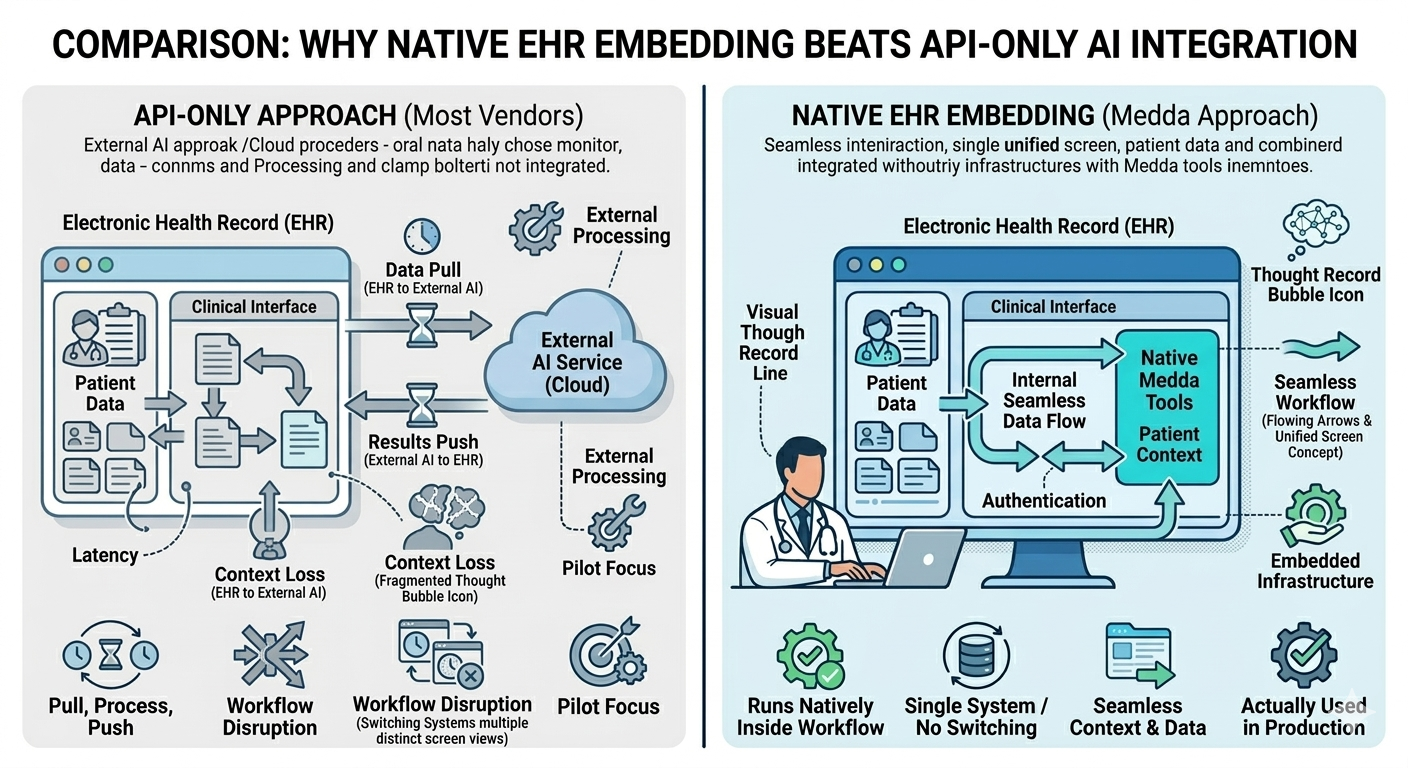
Most healthcare AI vendors integrate via APIs. They pull data out of the EHR, process it externally, and push results back. This creates latency, context loss, and workflow disruption. Physicians must switch between systems.
Medda takes a fundamentally different approach. Our applications run natively inside the EHR. When a physician uses a Medda tool, they never leave their clinical workflow. Patient context, authentication, and clinical data flow seamlessly because we are embedded at the infrastructure level, not bolted on at the API level.
This is not an incremental difference. It is the difference between a pilot that impresses and a production system that physicians actually use.
End-to-End Clinical Intelligence Pipeline
From EHR event to measured outcome. Every step production-hardened.
Why This Architecture Matters for AI
AI models are commoditizing. GPT-4, Claude, Gemini, open-source alternatives — the intelligence layer is becoming interchangeable. What is not interchangeable is the infrastructure that connects models to clinical reality.
Models Change. Infrastructure Persists.
We can swap AI models without disrupting clinical operations. Our monitoring, integration, and workflow layers are model-agnostic by design.
Data Access Is the Bottleneck
Real-time access to clinical events inside the EHR — not just historical data exports — is what enables production AI. We have had this for years.
Workflow Adoption Determines ROI
The best model in the world fails if physicians will not use it. Native EHR embedding eliminates the adoption barrier that kills most clinical AI pilots.
Download the Architecture Brief
A detailed technical overview of the Medda platform architecture for IT leaders and integration teams.
Download Architecture Brief